Something in the Water, Before I Even Reached the Coast
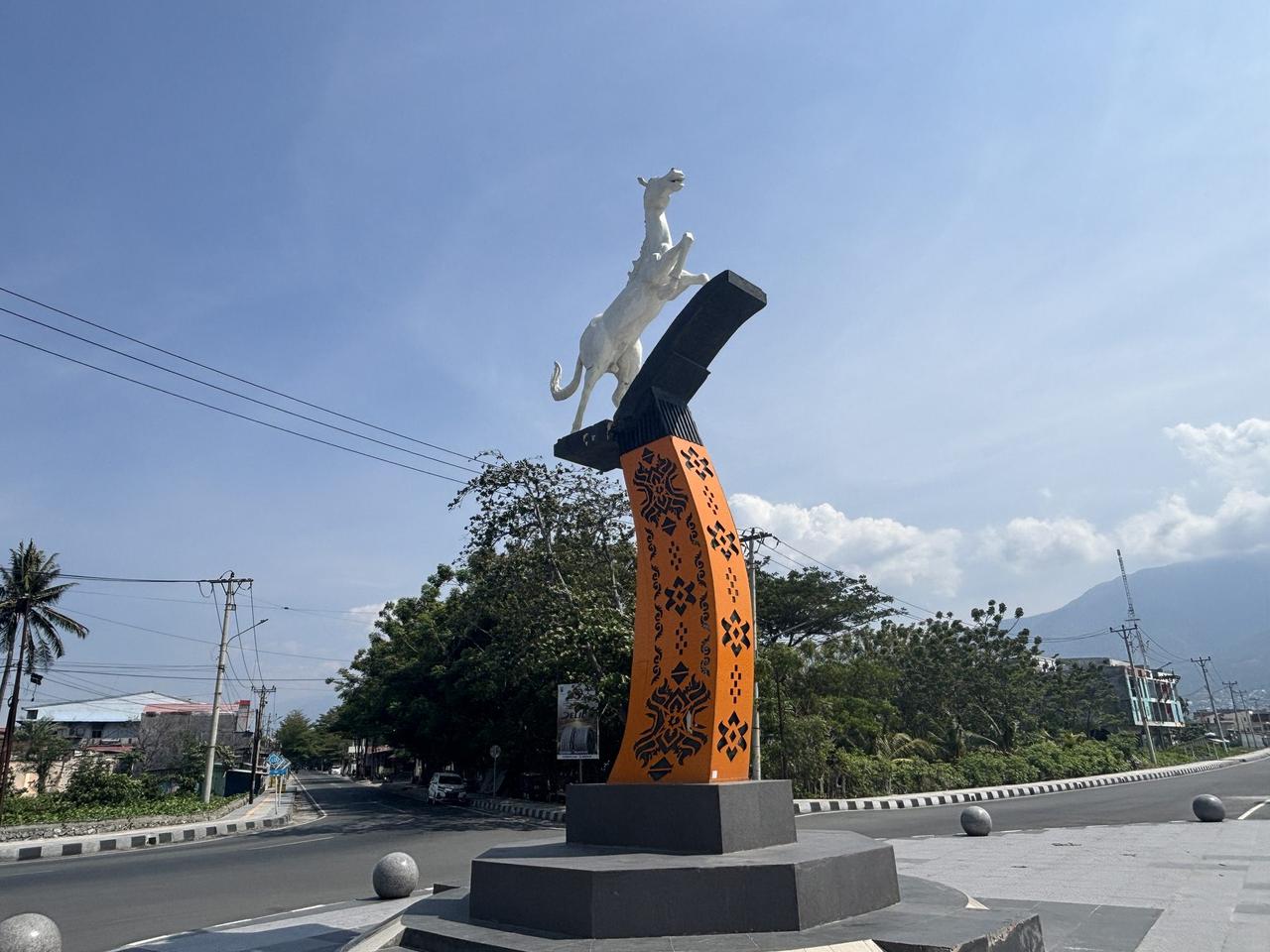
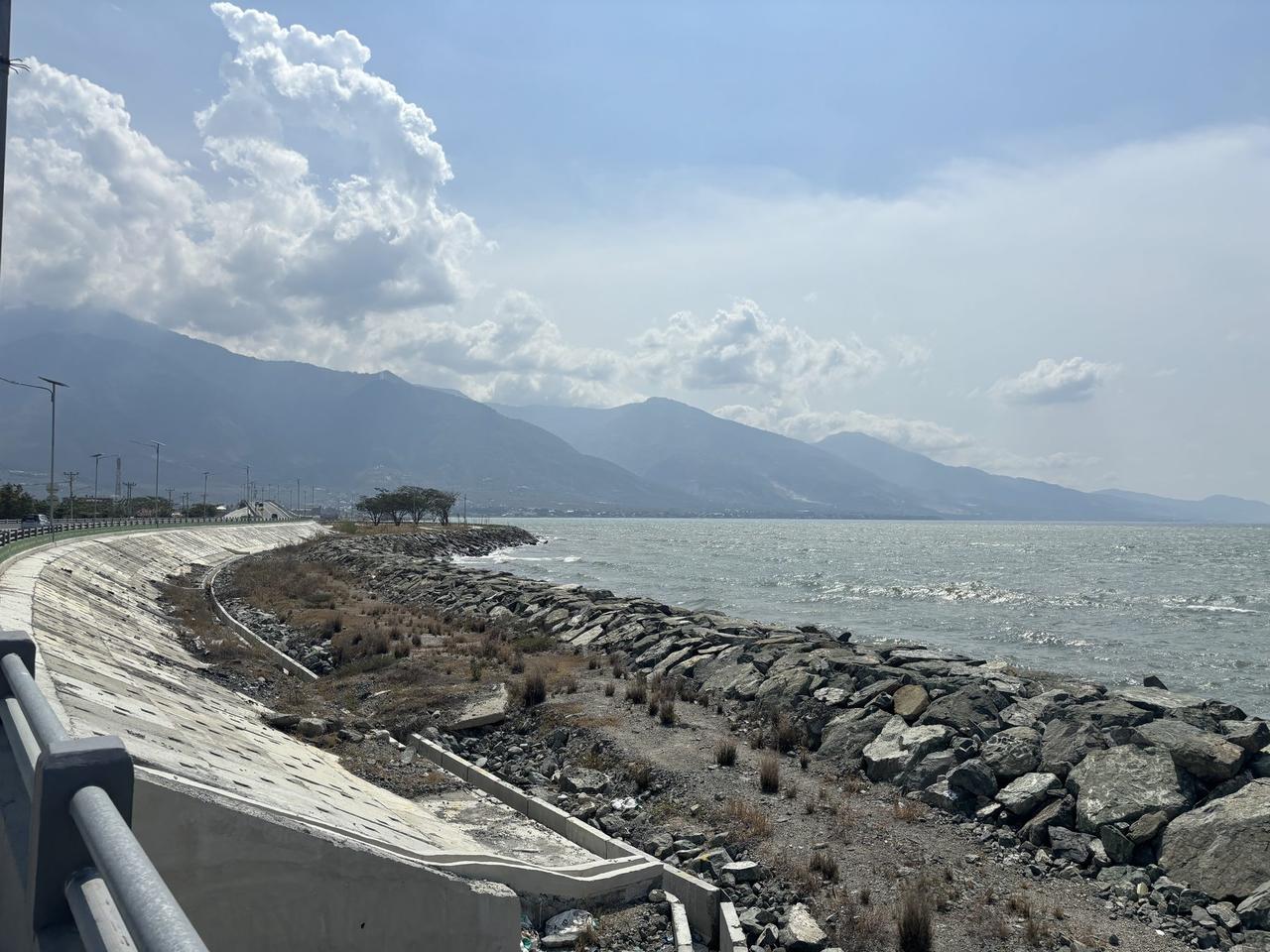
I hadn't gone looking for anything in particular that afternoon in Palu, just wandering toward the water the way I usually do in a new city. On the way, at a roundabout, a leaping white horse caught my eye, reared up on a black-and-orange pedestal patterned with the kind of geometric motifs that show up across this part of Sulawesi. I didn't know its story yet, only that it seemed like the kind of thing a city puts up when it wants you to notice you've arrived somewhere specific. I kept walking, past it, down toward the seawall that curves along Palu's bay.
A Shape That Wasn't a Floating Village
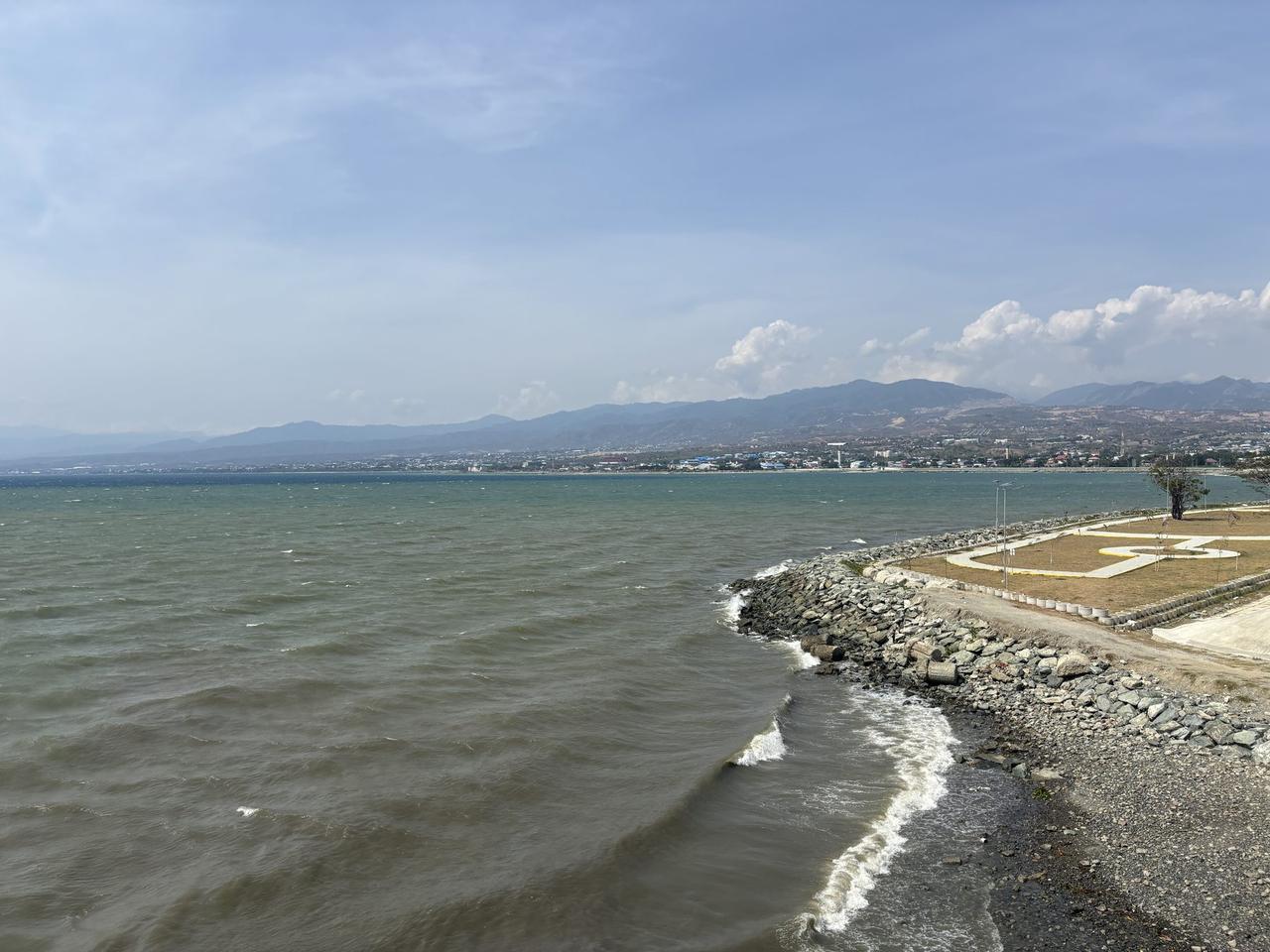
Further along the water, something caught my attention out past the shoreline — a shape sitting low over the surface, distinct from everything around it. My first guess was that it might be part of a floating settlement, the kind you see built out over water in a few places in this region. But there was only the one structure, and it was large, and the way it sat made it look almost like it was resting directly on the water itself rather than being held up by anything underneath. That didn't match a village. It was something else, and I kept walking toward it to find out what.
It Was a Mosque, Tilted, and Still Standing
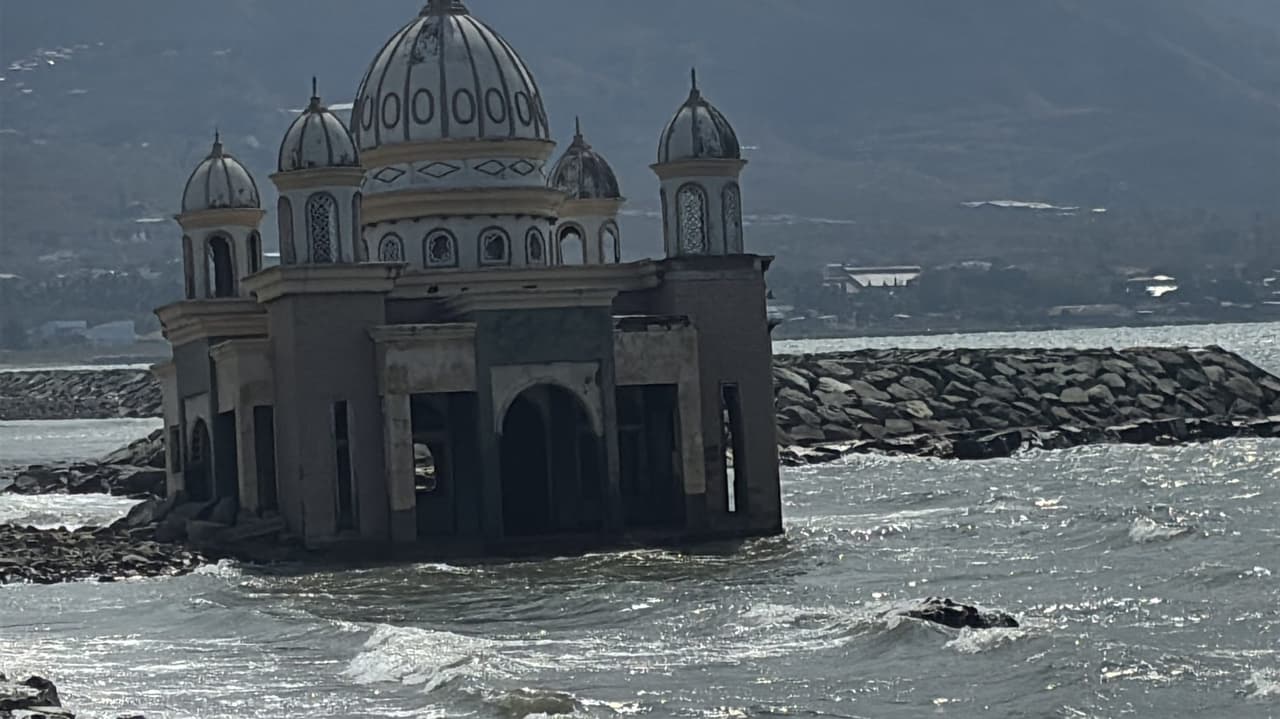
What resolved out of that shape, the closer I got, was a mosque — domed, clearly built to be beautiful once, and now leaning slightly, worn down, sitting out over the water on its own. Even in that condition it held my attention completely. I found out afterward that this is Masjid Arkam Babu Rahman, known locally as Masjid Terapung, the floating mosque, and that its tilt and its damage aren't accidents of neglect. They're what's left after the mosque went through something that leveled much of what stood around it, and came out the other side still on its feet.
Thirty Meters Out, on Twenty-Five Pillars
The mosque sits roughly thirty meters offshore, carried on twenty-five pillars driven ten meters down into the seabed. At low tide those pillars show themselves plainly, legs standing in exposed mud and shallow water; at high tide the water rises around them until the whole building looks like it's floating free, which is exactly the effect the name promises. Visitors normally reach it by a dedicated bridge lined with lights on both sides. At night, before the damage that changed all of this, the dome was lit in a rotating cycle of seven colors — red, orange, green, purple, blue, pink, white — switching every few seconds. It was never built to hold a crowd; capacity tops out around two hundred people. Even so, small as it is, it became one of the defining images of not just Palu but Central Sulawesi as a whole.
Built for a Scholar, and to Clean Up a Neighborhood
The mosque was built in memory of Datu Karama, born Sheikh Abdullah Raqie, the scholar credited with bringing Islam to Palu from West Sumatra in the seventeenth century. The idea came from Muhammad Hasan Bajamal, a local businessman who ran gas stations in the area; construction began on January 19, 2011, and finished exactly a year later, on January 19, 2012. The choice of site wasn't only about honoring Datu Karama. This stretch of waterfront had built up a reputation for its nightlife, bars and cafes and places offering more than either, and putting a mosque here was also, by most accounts, a deliberate move to change the character of the neighborhood.
The Earthquake That Didn't Take It Down
On September 28, 2018, a magnitude 7.5 earthquake struck with its epicenter in Donggala Regency, and what followed hit Palu as a combined disaster: the quake itself, then a tsunami, then liquefaction turning solid ground to something closer to liquid underfoot. More than 1,763 people died across the region, 1,519 of them in Palu alone, with 159 more in Donggala and 69 in Sigi. The city stopped functioning for days.
A wave roughly three meters high came through the bay and took nearly everything in its path. The floating mosque, against every reasonable expectation, did not go down with it. Half the building ended up underwater, and the bridge that had once connected it to shore was destroyed outright, but the structure itself held its shape and stayed standing, tilted but intact, in a way that turned it almost immediately into something people talked about.
A Silent Witness That Still Draws People at Sunset
The mosque hasn't functioned as a place of prayer since. It stands now, damaged and unrepaired, as what people here have taken to calling a silent witness, a physical record of what the earthquake, tsunami, and liquefaction did to this coastline. But the same tragedy that disabled it also seems to have made it more compelling rather than less. Locals treat the shoreline near it as a favorite spot for an evening walk, and especially during Ramadan it fills up with people waiting out the last stretch before iftar, ngabuburit, with the broken mosque as their backdrop. Sitting on the rocks nearby and taking a photo with it in frame has become an entirely ordinary thing to do here, and Palu's city government is reportedly working on plans to formalize the area as an official tourism and religious heritage site.
There's a thread running through a lot of what I'd already learned about Central Sulawesi's culture before I ever saw this place — the tau tau figures, the burial jars, the bark cloth, all of it built around some version of the relationship between death and renewal, ancestors and the people still living. Arkam Babu Rahman fits into that same pattern without trying to. It carries the memory of a disaster and, at the same time, gives the living a place to gather in the evening. Somewhere in that combination is most of what I came away with, standing on the shore looking at a mosque that should have gone down with everything around it, and didn't.