Something I Almost Walked Past
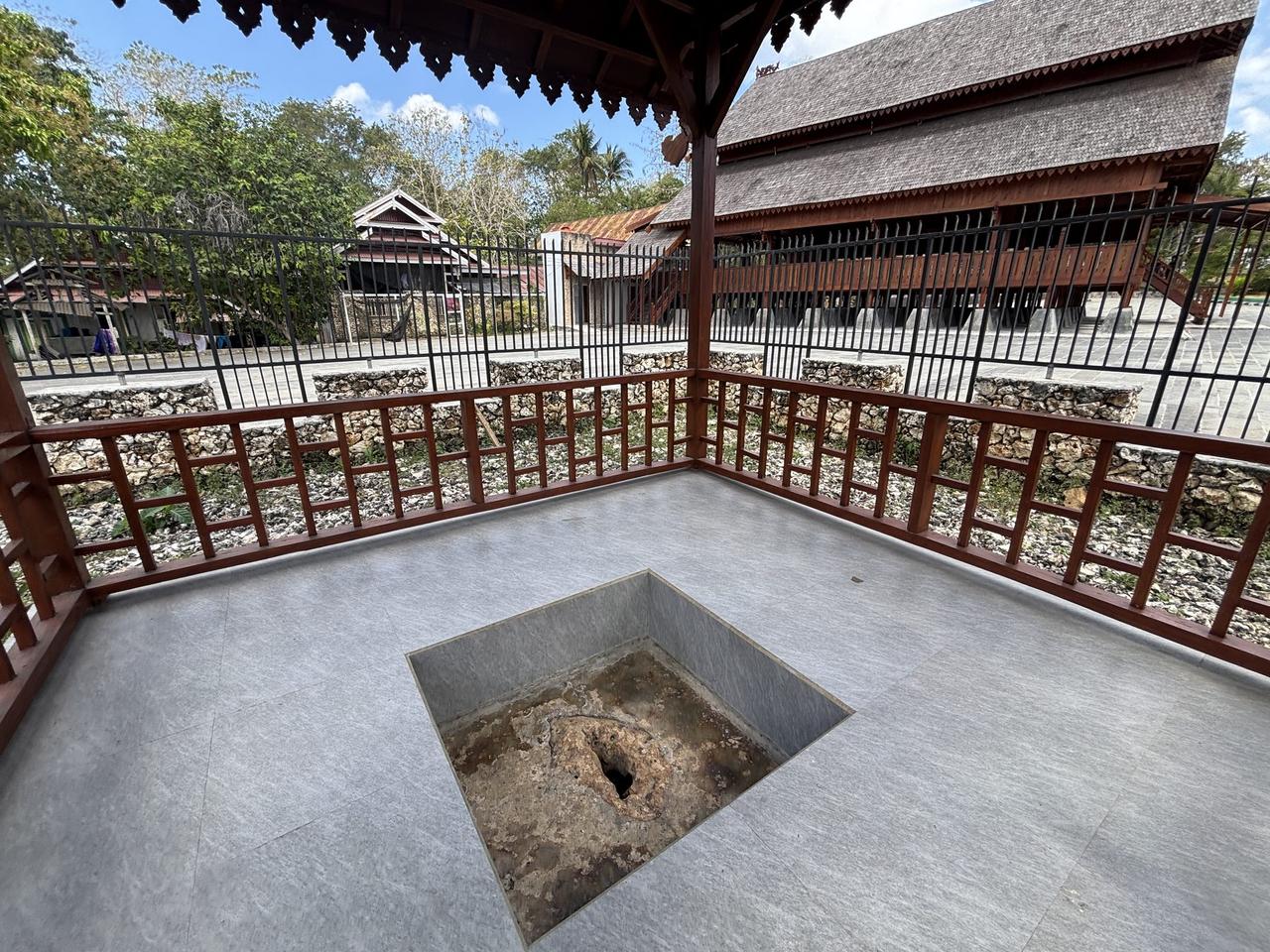
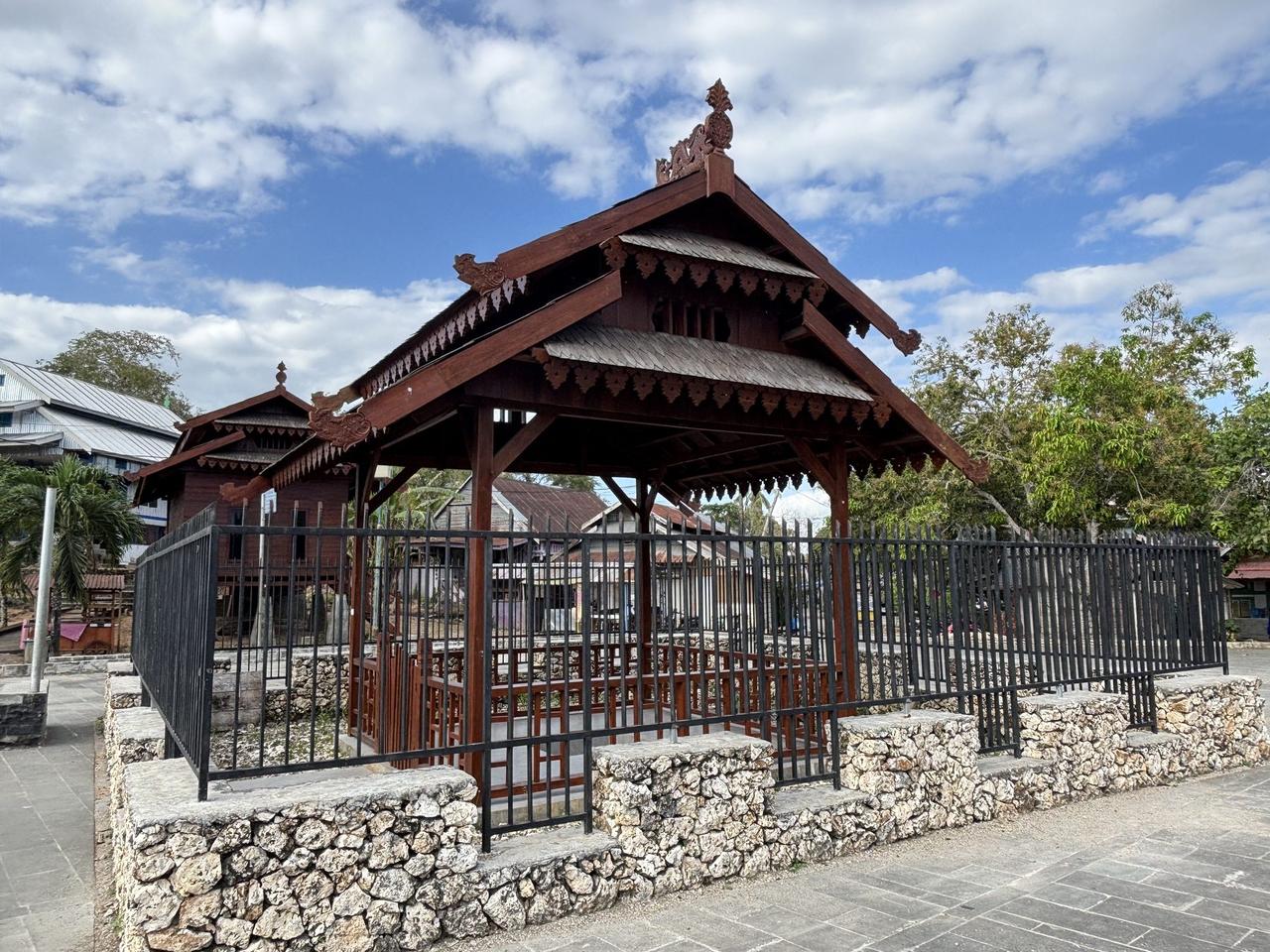
I found this one by accident, on the way to somewhere else entirely, wandering through Benteng Keraton Buton after already having seen the main sights inside the fortress. There was a small structure with a hole cut into the floor, fenced off, and I genuinely couldn't tell what I was looking at at first. My best guess was that something had simply fallen through and left a gap. It took paying a guide, somewhere around thirty to fifty thousand rupiah, to get the gate opened and actually learn what this was.
The Umbrella Stone
What I'd stumbled onto is called Batu Popaua, which translates roughly to Umbrella Stone. It sits inside Benteng Keraton, in Melai, Murhum district, directly in front of the Masjid Agung Keraton, the royal mosque, and right beside Baruga, the fortress's traditional meeting hall. Location alone tells you this isn't a minor curiosity; it's placed at the exact center of the fortress's most sacred cluster of buildings.
Where the Name Comes From
Popaua means something like "having an umbrella held over it," and the name refers to a specific gesture performed during a sultan's coronation: a royal umbrella, called a payung, was raised and rotated directly above whoever was standing on the stone at that moment. The stone also goes by other names depending on who's telling the story. Some call it Batu Ponu, for its resemblance to a turtle shell. Others describe it as a symbol of the feminine, tracing that association back to Buton's very first ruler, a queen.
A Footprint Cut Into Stone
The stone itself is modest in size, reported at around 50 by 35 centimeters depending on the source, but what actually stops you is the hole in its center: a depression roughly 80 centimeters long, shaped unmistakably like a human foot. Standing over it, once the guide pointed it out properly, I could make out what looked like individual toes in the outline. I'd walked past thinking it was just damage. It's actually the single most deliberate detail on the entire stone.
Wa Kaa Kaa's Footprint
According to tradition, this is the exact spot where Buton's first ruler, Queen Wa Kaa Kaa, first set foot on this land. From her reign onward, every ruler through the 38th sultan took their coronation oath standing at this same stone. That's not a loosely kept custom; that's an unbroken line running from the kingdom's founding to nearly its end, all anchored to one physical spot.
A Coronation That Took Days, Not Minutes
Local cultural custodians and university lecturers who study Buton history describe a coronation process that unfolded over several days rather than a single ceremony. Preparation began Thursday evening, even though the formal event happened Friday. The candidate was ritually bathed using water drawn from four separate springs across the Buton kingdom, then dusted with a mixture of 120 different scented powders, each one meant to represent a different human emotion, joy, pain, anxiety, hardship, so the future ruler would carry an understanding of everything the people themselves might feel. Friday brought formal white dress, a gold sash, and a procession to the royal mosque for prayer, followed by a coronation performed by someone considered a descendant of the Prophet Muhammad. Only then came the oath at Batu Popaua itself: facing west, one foot placed into the stone's hollow, the royal umbrella turning overhead as the new ruler received their charge. From there, the newly sworn sultan moved next door to Baruga to receive envoys and pledges of loyalty from across the region.
What the Oath Actually Said
The substance of the oath wasn't ceremonial fluff. It bound the new ruler against corruption and nepotism specifically, and the consequence for breaking it was described in stark terms: no peace in this life or the next, extending as a burden across seven generations of descendants. That's a genuinely heavy thing to say out loud with one foot already inside the stone.
Elected, Not Simply Inherited
This connects directly to something I'd already noticed at Istana Malige, where a carved pineapple motif symbolizes that the throne wasn't meant to be treated as a family heirloom passed automatically down a bloodline. Starting with the fourth sultan in 1597, Buton's rulers stopped being chosen purely by birthright and were instead selected through Siolimbona, a body representing the people that functioned something like an early parliament. Before that point, a ruler's children were automatic candidates; after it, selection by public representation held all the way through to the kingdom's final sultan. Batu Popaua isn't just where oaths were sworn. It's the physical stage where that entire system of accountable, representative succession played out, generation after generation.
Protected and Guided Today
The stone is now fenced to keep out both wildlife and careless foot traffic, with a semi-permanent roof built in traditional Buton style protecting it overhead. Tiled flooring and signage have been added around it, and the surrounding area has picked up the usual tourism infrastructure, parking, souvenir stalls, a cafe or two. Visiting generally requires a local guide; a small fee covers photos alone, while a proper explanation, the kind that actually makes sense of what you're looking at, comes with a guided plan.
Four Hundred Years, One Small Stone
I'd already spent a day being impressed by scale, first the sheer size of Benteng Keraton, then the density of history packed into Istana Malige. Batu Popaua works the opposite way. It's small enough to miss entirely if a guide doesn't point it out, and yet it holds the same weight as everything around it: a queen's first footstep, thirty-eight successive oaths, and a governing philosophy that insisted, well before most of the world's monarchies caught up to the idea, that power should answer to something outside itself.