Getting There Took Longer Than Expected
I only had one full day in Baubau, and this was the one thing on my list I wasn't willing to skip: Benteng Keraton Buton, said to be the largest fortress in the world. Walking there from town would have taken close to an hour, so I called a Grab instead and rode up the hill. Even then, arriving didn't feel like arriving anywhere in particular. There was a slope, then more of the slope, and at some point I was apparently inside the fortress without ever having passed through anything that looked like a gate. It was too big to register as a castle. It just looked like more hillside.
A Guinness Record, Not Just a Local Boast
What I didn't fully appreciate until later was how literally enormous this place actually is. In September 2006, it was certified by both Indonesia's MURI record body and Guinness World Records as the largest fortress in the world: a total area of 23.375 hectares, walls running 2,740 meters in a rough circle, sitting on a hilltop roughly 100 meters above sea level. Comfortable shoes aren't optional here. Seeing the whole thing properly takes real time and real stamina, which explains a lot about how disoriented I felt walking in without a map.
Built Across Three Reigns
Construction started in the 16th century under Buton's third sultan, La Sangaji, known by the title Sultan Kaimuddin, who reigned from 1591 to 1596. What he built was reportedly modest at first, closer to a stone fence separating the royal residence from the surrounding settlement than a fortress. It grew from there. Under the fourth sultan, La Elangi, titled Sultan Dayanu Ikhsanuddin, around 1613, proper bastions and storehouses were added. The fortress wasn't considered complete until the reign of the sixth sultan, La Buke, in 1645. That's three sultans and roughly half a century of construction, the same kind of multi-generational project that produced Gowa's Benteng Somba Opu, which took five rulers and 145 years to finish.
Coral Stone Held Together With Egg White
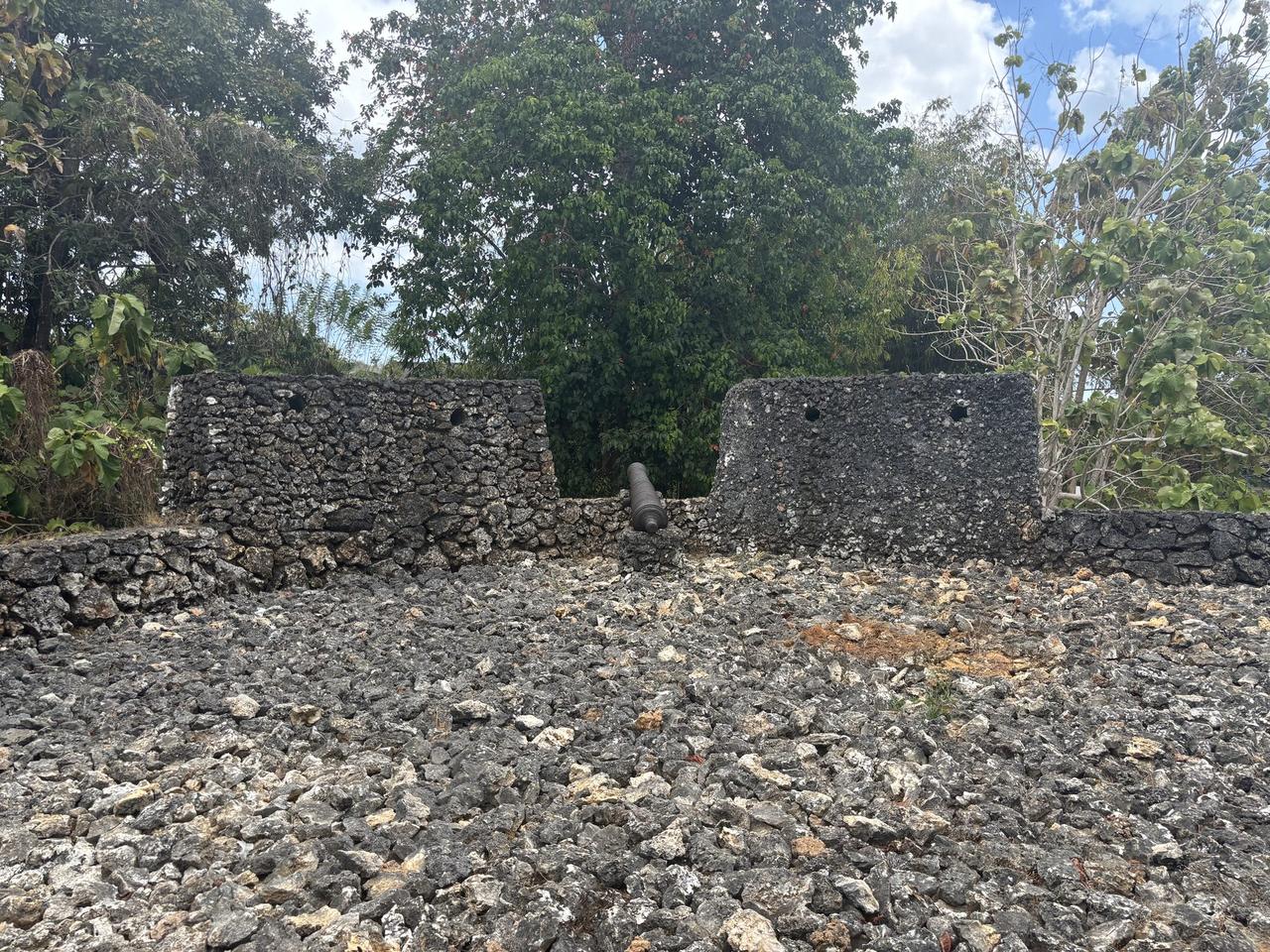
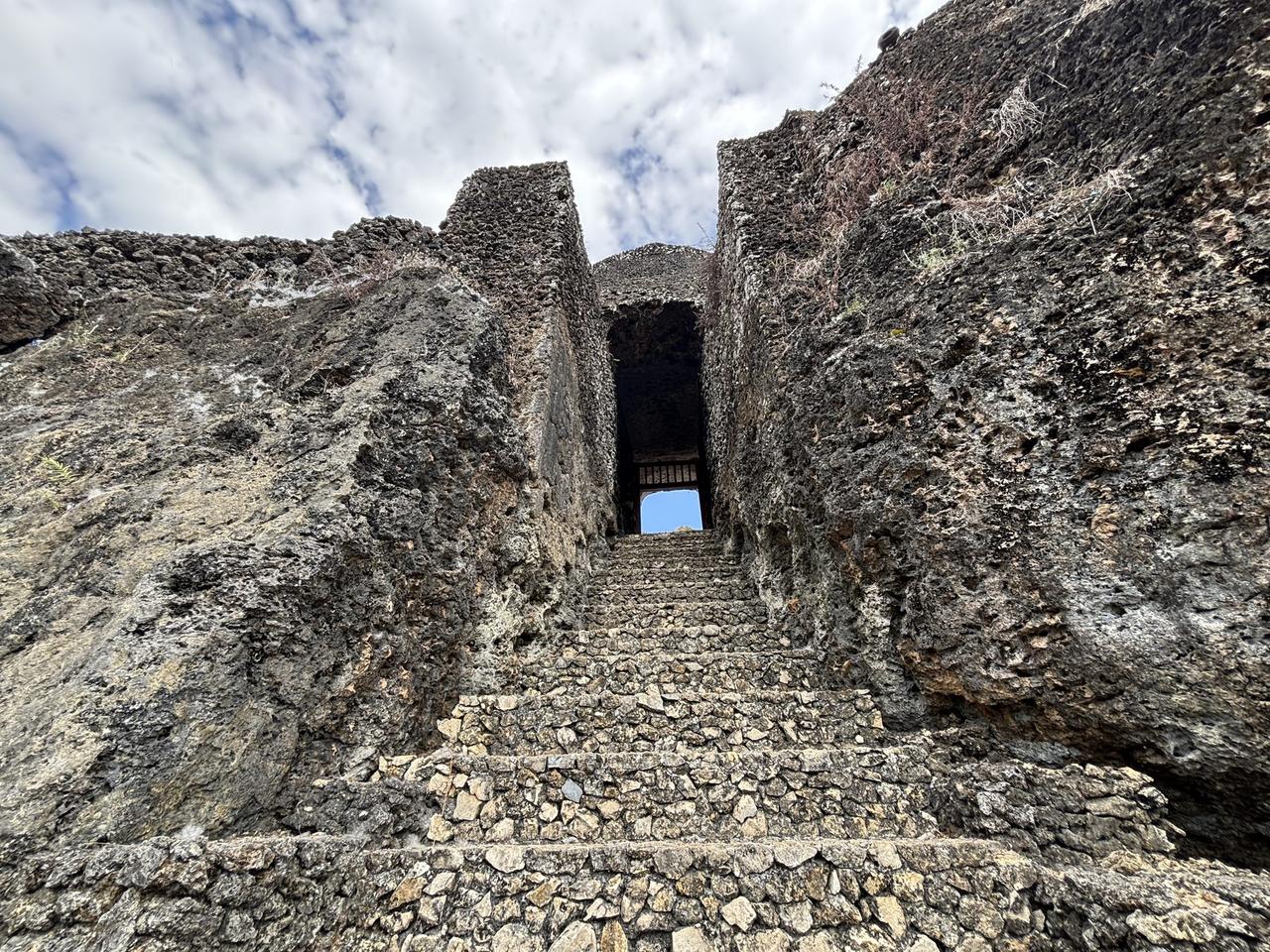
The building method is as distinctive as the scale. Walls were built from karst limestone, bonded with a mortar mixed from egg white, sand, and lime, a formula I hadn't heard used anywhere else. Height and thickness both vary depending on the terrain, ranging from 1 to 8 meters tall and 0.5 to 2 meters thick, with the tallest, heaviest sections concentrated on the east and south sides. Earthen embankments called turap reinforced the interior in places, and combined with the steep hillside the fortress sits on, the whole thing reads as a genuinely serious piece of 17th-century defensive engineering, not a ceremonial wall.
Realizing Where I Actually Was
I wandered for a while before a woman stopped me to say that visiting properly required a small entrance fee. It wasn't expensive, but that was the moment it actually registered that I was already standing inside Benteng Keraton Buton, not approaching it. Nothing about the scale had announced itself the way a castle gate normally would. The fortress simply absorbs you before you notice.
One of Twelve Named Gates
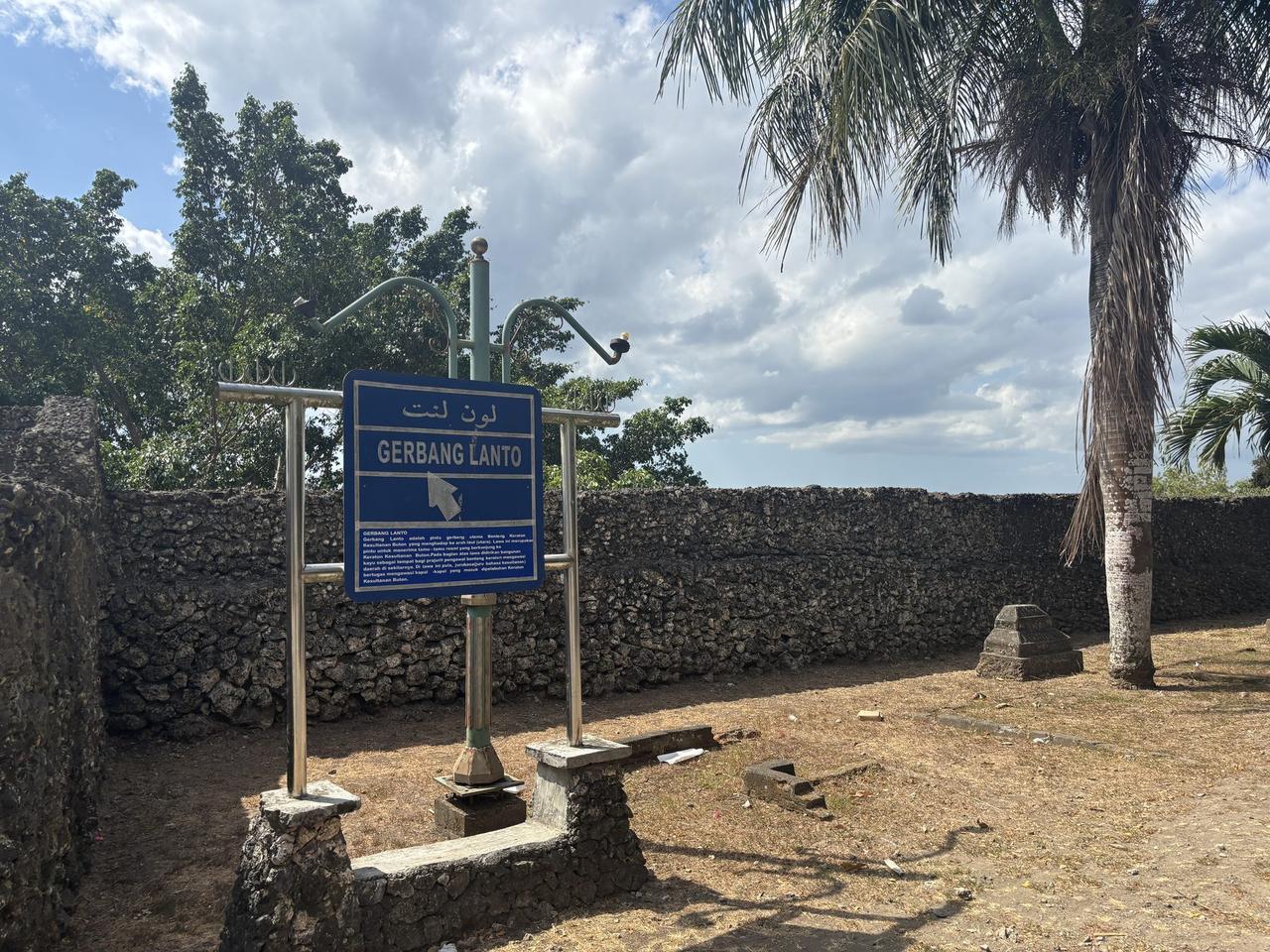
Partway through, I came across a sign marked Gerbang Lanto, one of the fortress's twelve gates, known locally as lawa. This particular one faces north toward the sea and historically functioned as the main entrance for receiving official guests arriving at the sultanate's port. A wooden structure once stood above the gate itself, used by guards keeping watch over the surrounding area, and by court interpreters monitoring ships entering the harbor below. Finding a labeled gate like this made the fortress's scale click into place in a way that just walking through open ground hadn't managed to.
Sixteen Places to Mount a Cannon
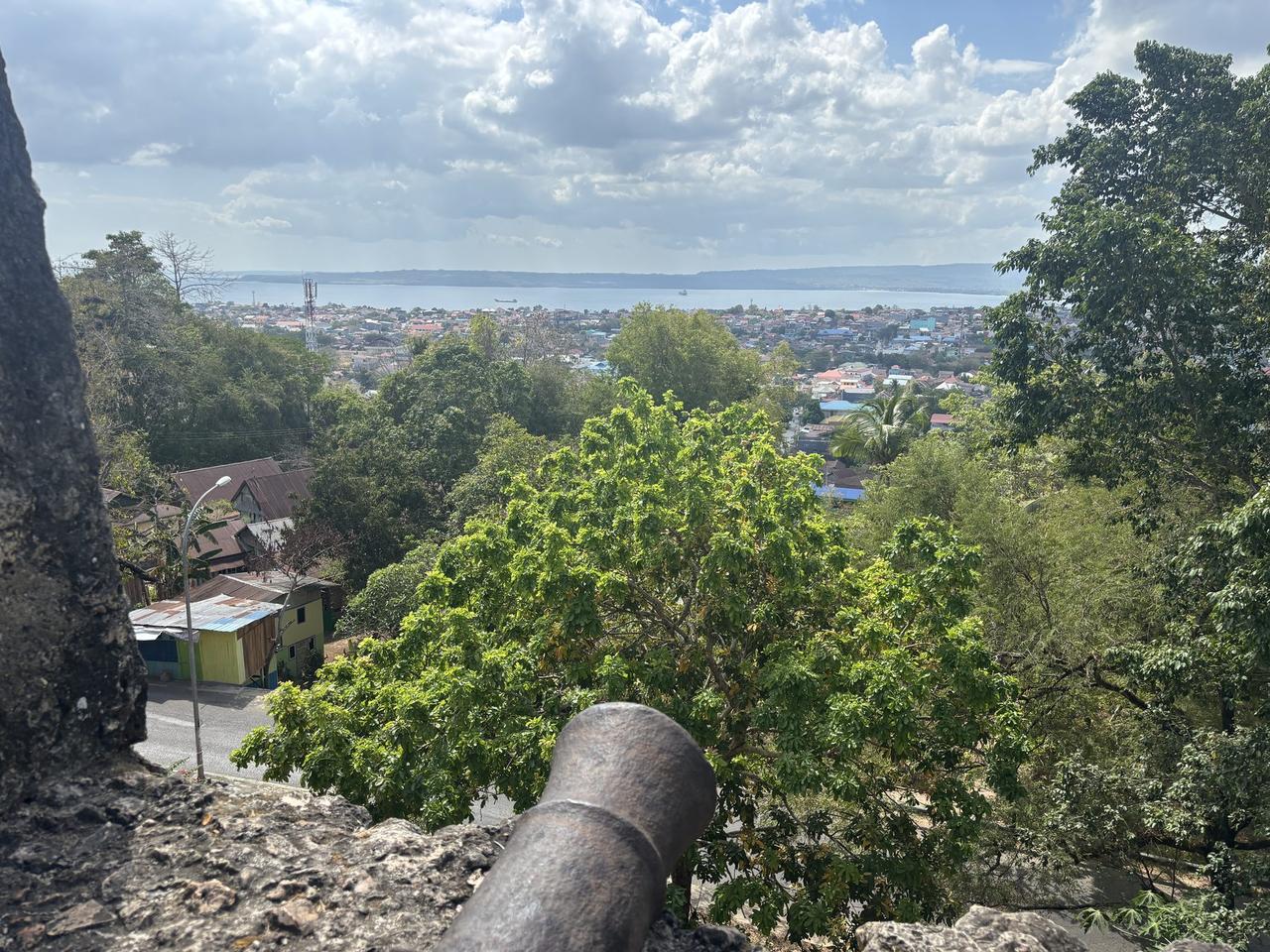
Along with the twelve gates, the walls hold sixteen former cannon positions, called baluara, and watchtower bastions positioned at each of the fortress's four sides. Cannons here were reportedly Portuguese and Dutch in origin, physical evidence of the same tension with European colonial powers that shaped Gowa's history in Makassar. Standing at one of these positions, looking out over the wall toward Baubau and the strait beyond, it wasn't hard to picture what all that firepower had once been aimed at.
More Town Than Fortress
The strangest, most memorable part of the visit was realizing that people actually live inside these walls, in the ordinary sense of the word. The fortress is so large that it contains what's probably several hundred houses, an entire settlement called Limbo Wolio, and plenty of those houses use traditional Wolio building techniques that are still practiced today. I ended up talking with a guide along the way, who told me that modern-style houses have been creeping in gradually, but that people here still want to hold onto the traditional building methods rather than let them disappear. It's one thing to read that a fortress contains a living village. It's another to be standing inside someone's actual neighborhood and realize the walls around you are the same ones built four centuries ago.
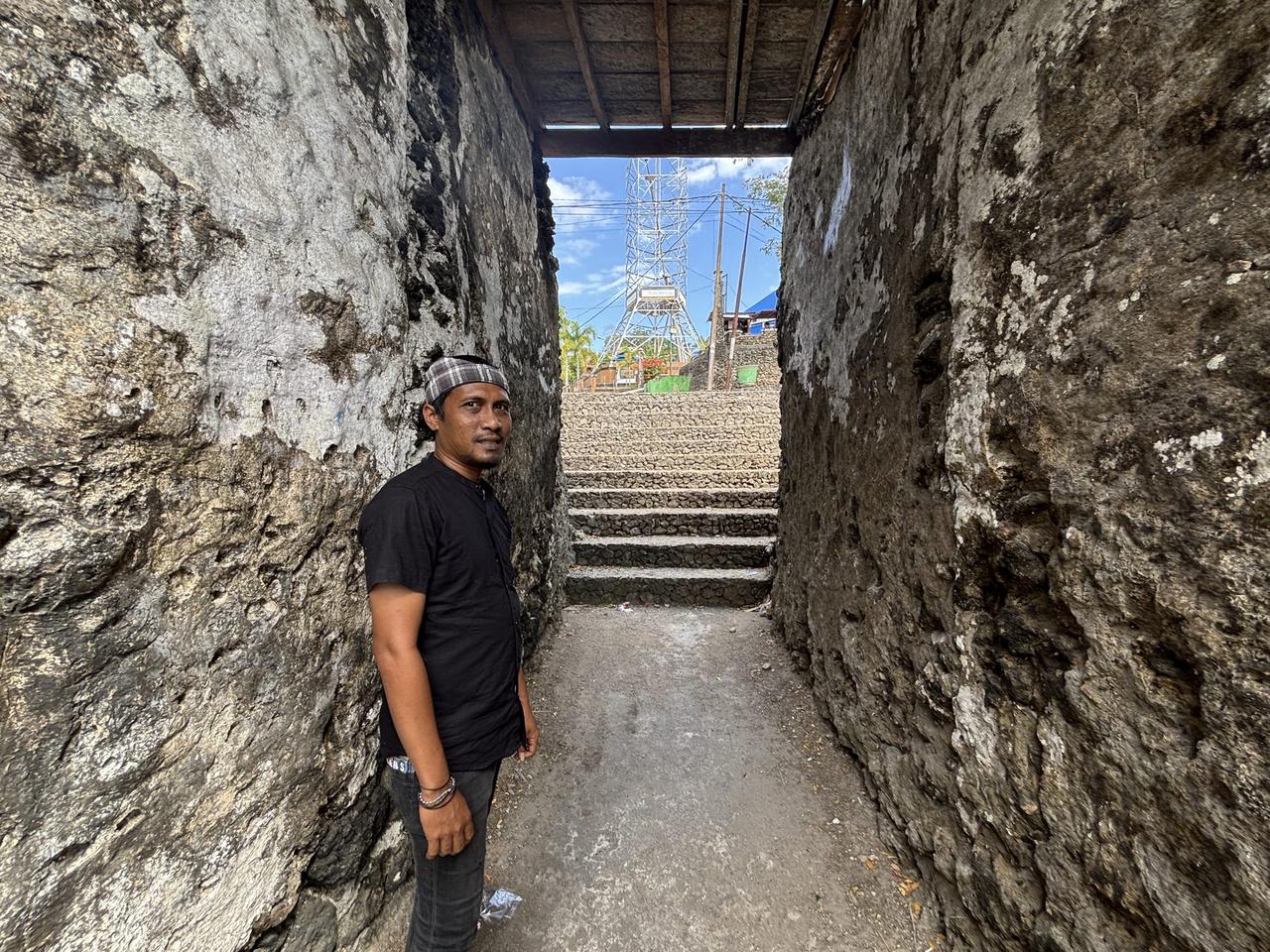
Beyond the houses, the fortress also holds Buton's royal mosque, a marble-faced building of about 40 square meters completed in 1712 under Sultan Sakiuddin Darul Alam, considered the oldest mosque in Southeast Sulawesi, along with the tombs of past sultans. Between the mosque, the graves, the village, and the palace I'd already visited on an earlier trip, this stopped feeling like a fortress and started feeling like a walled city that happened to also be a fortress.
A Kingdom That Was Never Fully Colonized
One detail the guide mentioned stuck with me more than almost anything else: the Buton Sultanate is often described as a kingdom that was never fully colonized by an outside power. That stands in sharp contrast to Gowa, whose own Benteng Somba Opu fell to the Dutch after the Makassar War and was largely destroyed. Buton, protected behind these walls, managed to hold onto its own governance for far longer. Standing at a cannon position built explicitly against that kind of outside pressure, the history stopped being an abstract fact and started feeling like the actual reason the walls were built this thick in the first place.
A Village on Its Way to World Heritage Status
Local authorities and historians are currently pushing to have the fortress recognized as a UNESCO World Heritage Site, and there are signs the momentum is real. Limbo Wolio, the village inside the fortress walls, was ranked among the top 50 villages out of 3,500 entries in Indonesia's 2022 Tourism Village Award, a level of national recognition that suggests this isn't just a local talking point.
Worth Every Step of the Climb
By the end, I understood why people say this place is better seen by motorbike than on foot; there was simply too much of it to cover properly in the time I had. But I also got what I came for: gates, cannon positions, a working village, a view over the entire city of Baubau and the strait beyond it, and a sense of a sultanate that built its own survival directly into stone. Between the history the guide walked me through and the sheer scale of what I was standing inside, it turned out to be exactly the kind of day I'd hoped for when I decided this was the one thing in Baubau I wasn't going to miss.