June 2026 — written from Balamban, Cebu
The first thing I noticed in Balamban wasn't a landmark. It was the smell of the sea.
I had spent four days walking from Cebu City, cutting straight through the middle of the island over the mountains, roughly following the line of the Transcentral Highway. Four days of climbing, ridgelines, and rain. So when the road finally tipped downhill and the Tañon Strait opened up in front of me — flat, calm, and quietly glittering — it honestly felt like a reward. I finally made it to the coast.
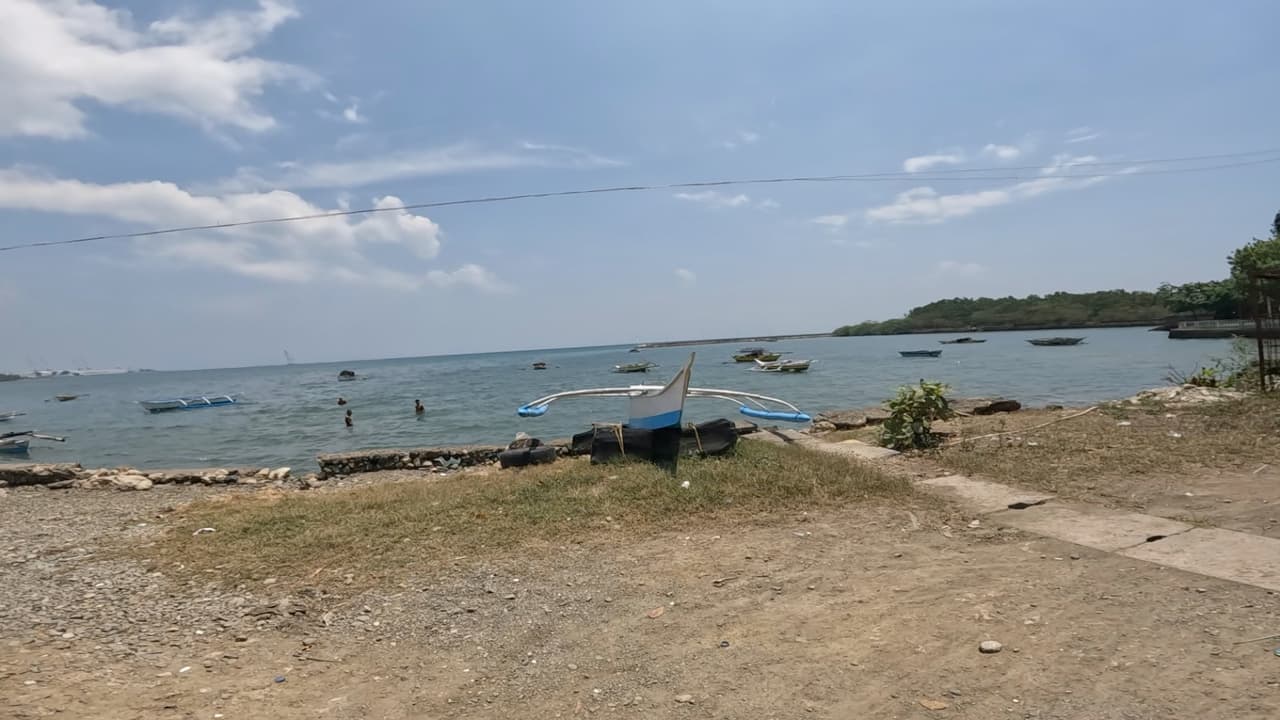
Most travelers never see Balamban. It sits on the west coast of Cebu, on the opposite side of the island from Cebu City, Mactan's resorts, and the airport. There's no famous beach here, no whale sharks, no Instagram staircase. And that's exactly why I want to write about it — because Balamban turned out to be one of the most quietly interesting towns I've visited in the Philippines, and there's almost nothing written about the town itself in English.
Where Is Balamban, and Why Does It Exist?
Balamban is a first-class municipality on Cebu's western coast, facing the Tañon Strait — the channel that separates Cebu from Negros. From Cebu City, it's connected by the Transcentral Highway, a winding mountain road that crosses the island through the Central Cebu Protected Landscape. By v-hire or bus it takes roughly 1.5–2 hours; on foot, as I can now confirm, it takes considerably longer. (The walk itself — including getting lost in a rainstorm on the way down and the day I finally reached town — is a story of its own.)
The name is said to come from a local word for "butterfly," which suits the scenery — mountains at its back, sea at its front. But the modern town runs on something much heavier than butterflies: ships.
A Japanese Shipyard at the End of the Road
Here's the part that genuinely surprised me as a Japanese traveler. Balamban is known as the shipbuilding capital of the Philippines, and the company at the center of it is Tsuneishi — a shipbuilder from Hiroshima. Tsuneishi Heavy Industries (Cebu) was established in 1994 as a joint venture with the Cebu-based Aboitiz Group, and its shipyard in the West Cebu Industrial Park now supports more than 12,000 jobs. They build enormous bulk carriers here — by 2021 the yard had delivered its 300th ship.
I walked across a Philippine island for four days, came down the far side of the mountains, and arrived in a town that was — in an economic sense — partly built by a company from Hiroshima. It's a strange feeling, standing in a busy Visayan market town and realizing that the paychecks circulating around you trace back to the same shipbuilding tradition as the towns along Japan's Seto Inland Sea. The connection is still growing: as of mid-2026, Tsuneishi has announced plans to further expand and modernize the Balamban yard, including a new dry dock.
You can't casually tour the shipyard, and honestly you don't need to. Its effect is visible everywhere in town instead: in the traffic, the crowds, the money moving through the market.
A Town That Feels Full — in a Good Way
That's the thing about Balamban that my notes keep coming back to: density. For a town of its size, it feels full. Tricycles and motorbikes everywhere, sidewalks busy, two Gaisano stores anchoring the commercial strip — the older Gaisano sari-sari store near the town center and the big blue-and-yellow Gaisano Grand mall on the highway. It also helps that Toledo, the next city down the coast with its port, is close by; this stretch of the west coast is a working corridor, not a sleepy backwater.
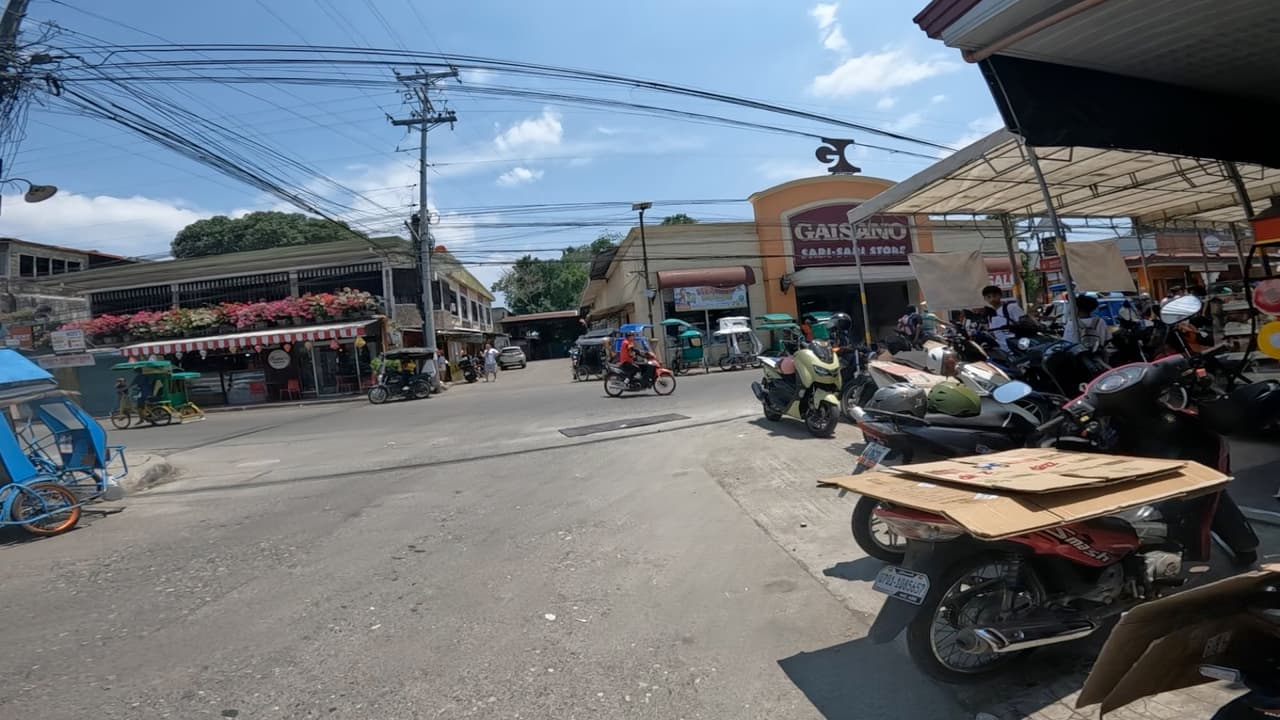
In some towns, crowds read as stress. Here it read as energy. Nobody was performing for tourists, because there aren't any. People were just going about their day at full volume, and as a visitor I found that far more enjoyable than any curated attraction.
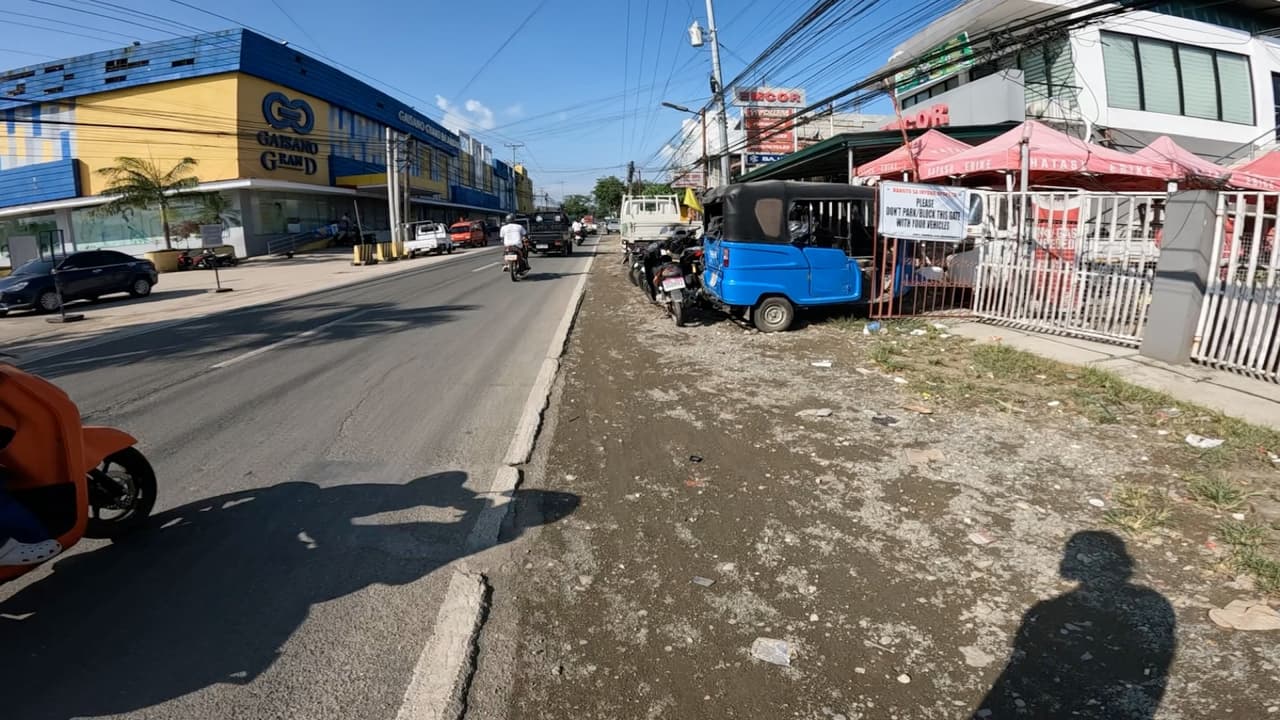
Coming from Japan, where regional towns of this size are often visibly aging and emptying out, the contrast was striking. Balamban feels young and busy in a way that a similar-sized coastal town in, say, rural Hiroshima usually doesn't anymore. Ironic, given who runs the shipyard.
The Kindness Test (Which I Failed to Plan For)
My most vivid memory of Balamban is not the shipyard or the market. It's a stranger's bathroom.
Somewhere in town, my stomach suddenly turned on me — badly, urgently, in the way that ends trips. I must have looked as desperate as I felt, because a local family simply waved me into their house and let me use their toilet. No hesitation, no suspicion of the sweaty foreigner with a trailer. Just: come in, it's over there.
Around the same time I got talking with a young local guy whose English was so fluent it stopped me mid-sentence. He wasn't using it for a call-center job in the city; he was home, working to help support his parents. That combination — real ability, and the choice to point it at family first — stayed with me.
People say the Philippines is a country overflowing with kindness, and after seven weeks walking across it I can confirm the cliché is simply true. But in Balamban, a town with zero tourism playbook, the kindness had nothing transactional about it. It was just how people are.
Evenings Are the Best Time
If you only have one evening in Balamban, spend it the way locals do. From around 5 to 6 p.m., the town shifts gears. People pour into the area around the Balamban public market, and the whole center takes on a festival-adjacent buzz — food, noise, motorbikes, kids, everything at once. The market leans toward fresh catch and daily produce rather than souvenirs, which is exactly what makes it worth walking through.
The other evening spot is the waterfront. The shoreline near town isn't a resort beach — it's a working one, with outrigger bangka boats pulled up on the grass and kids swimming between them. In the late afternoon, couples sit along the seawall watching the light change over the Tañon Strait. I found myself doing the same thing, minus the couple part. It was one of those small, unglamorous scenes that stay with you longer than the famous viewpoints do.
Room to Move: The Sports Field at Dusk
One more thing I didn't expect from a provincial Philippine town: space to exercise. Balamban has an open sports ground where, as the heat finally breaks in the evening, the whole neighborhood shows up — kids playing football on the pitch, adults doing laps around the dirt track, bicycles parked against the fence.
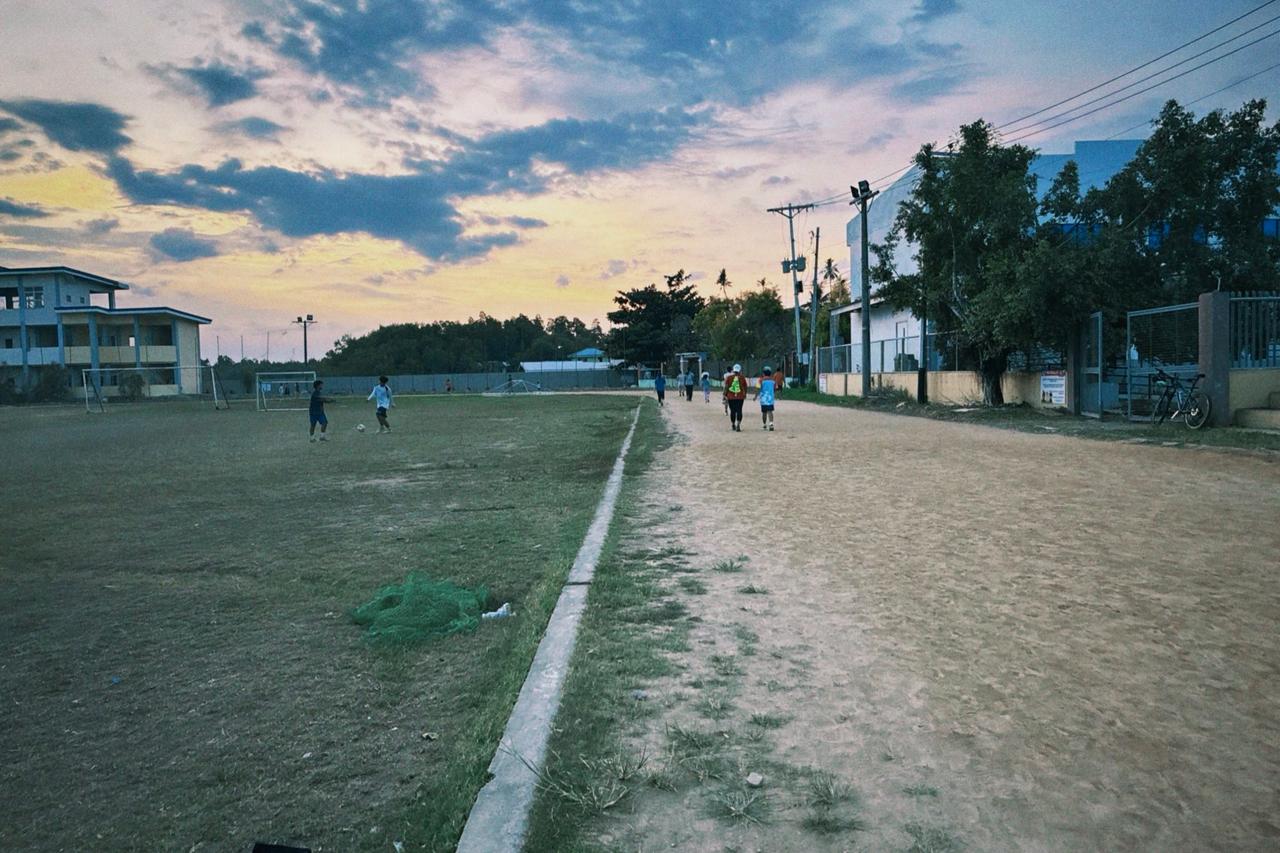
I joined the walkers for a couple of laps. After four days of mountain walking my legs didn't need it, but there's something about circling a dusty track at sunset with strangers that makes you feel briefly like a resident instead of a visitor.
Where I Stayed: Caliah Homes
I spent my three nights in Balamban (June 6–8, 2026) at Caliah Homes, a family-run guesthouse on Pondol Road. My room was simple but genuinely comfortable — proper bed, air-con, a mini fridge and kettle, towels folded on the sheets — which, after four days of walking over the mountains, felt like luxury.

The location works well: about a minute's walk from the Gaisano Grand mall for supplies, and roughly ten minutes on foot to the waterfront. If you're passing through Balamban on a Transcentral Highway trip or a west-coast route, it's an easy recommendation.
Booking: Agoda | Booking.com Price: I paid around ₱1,600 per night (about US$28).
Should You Actually Go?
Honest answer: Balamban is not a destination you fly to Cebu for. There's no single sight here that justifies the trip on its own. But it's an excellent town in three specific situations:
If you're crossing the Transcentral Highway anyway. Most people drive the mountain road for the highland cafes and views, then turn back. Continuing down to Balamban gives the drive an actual destination — a real town with a real evening scene, instead of a U-turn at a viewpoint.
If you want to see everyday Cebu. The island's tourism runs on beaches and diving. Balamban shows you the other Cebu: an industrial, working, crowded, cheerful coastal town where the economy is ships, not snorkels.
If you're heading up or down the west coast. With Toledo and its port just to the south, Balamban works naturally as an overnight stop — it's exactly how I used it before walking on to Toledo and crossing to Negros.
Practical Notes
(as of June 2026)
- Location: West coast of Cebu, facing the Tañon Strait
- From Cebu City: Via Transcentral Highway; bus/v-hire approx. 1.5–3 hours depending on traffic
- Bus fare: Roughly ₱100–120 (about US$1.70–2.10) from Cebu North Bus Terminal
- Known for: Shipbuilding (Tsuneishi/West Cebu Industrial Park), public market, mountain access
- Where to stay: Caliah Homes (Pondol Road, near Gaisano Grand)
- Best time of day: Late afternoon to evening (market crowds, waterfront, sports ground)
- Tourist infrastructure: Minimal — basic guesthouses and local eateries; this is a working town
⚠️ One real warning: the Transcentral Highway is beautiful but genuinely hazardous — it's known for sharp curves, accidents, and landslides during heavy rain. If you're driving or riding it (or, less advisably, walking it like I did), avoid the road in bad weather and give yourself daylight hours.
I came down out of the mountains expecting a place to rest before moving on. Instead I got a small lesson in how a town works — how a shipyard from my own country, mountains, a strait, a public market, and one very kind family with an open bathroom door can add up to somewhere that feels completely alive at 5:30 in the evening. Balamban won't make anyone's top-ten Cebu list. It made mine.
Facts in this article are accurate as of June 2026. For background on Balamban's shipbuilding industry, see Tsuneishi Shipbuilding's official page on its Cebu operations.
This post contains affiliate links — if you book through them, I earn a small commission at no extra cost to you.